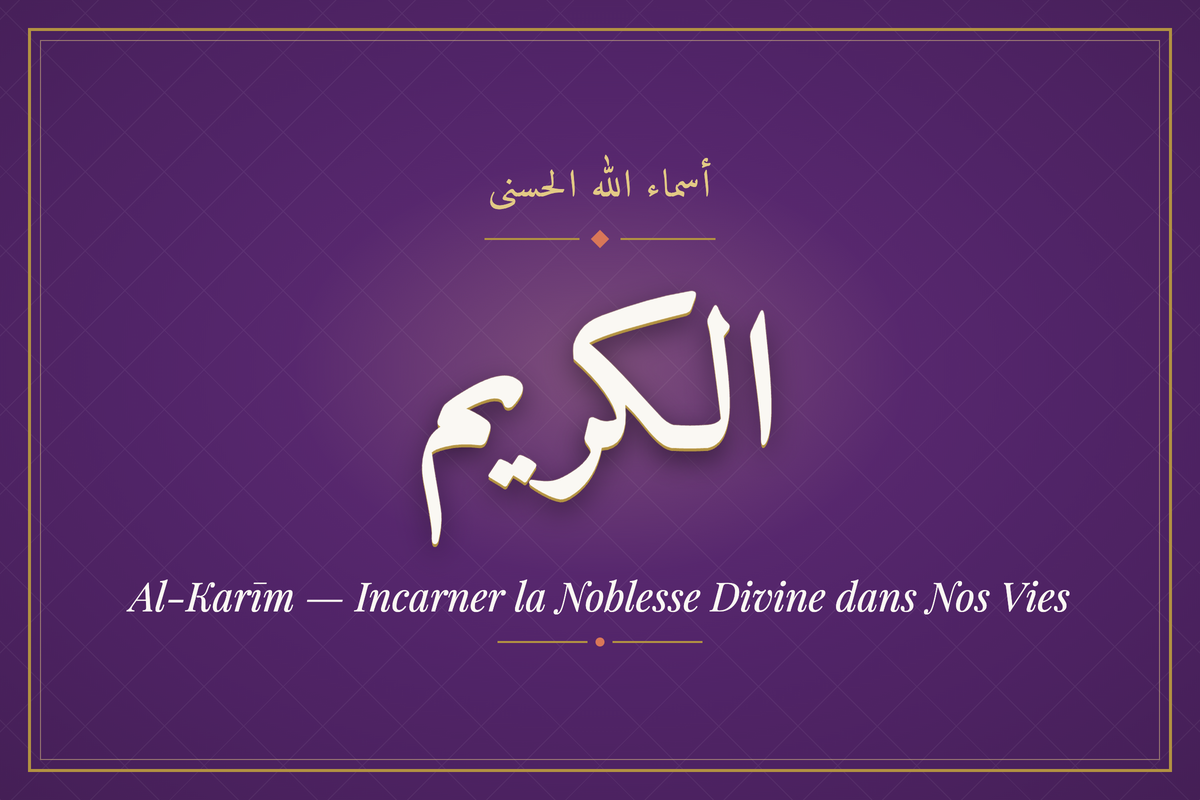
Al-Karīm (الكَرِيم), "The Noble," "The Generous par excellence," is one of the most beautiful Names of Allah. It designates the One whose generosity expects neither merit nor reciprocity: He gives before one asks Him, forgives when He could punish, and honors His servants beyond what they hope for. To meditate on this Name is to learn both to receive with gratitude and to give with nobility.
What does Al-Karīm mean?
The name Al-Karīm comes from the Arabic root kāf-rā'-mīm (ك ر م), which expresses nobility, generosity and honor — the root of the word karam (generosity, magnanimity). Applied to Allah, this Name designates:
- Limitless generosity: Allah gives abundantly, without counting, without impoverishing Himself and without recalling His favors to humiliate.
- Perfect nobility: His acts are all marked by greatness — He forgives when He could punish, conceals faults when He could expose them.
- The One who honors His creatures: "We have certainly honored (karramnā) the children of Adam" (17:70) — human dignity itself is a gift from Al-Karīm.
Al-Karīm in the Qur'an
Allah addresses man by this Name in a striking verse:
يَا أَيُّهَا الْإِنسَانُ مَا غَرَّكَ بِرَبِّكَ الْكَرِيمِ
"O man! What has deceived you about your Lord, the Noble?" (Surah Al-Infitār, 82:6)
And the prophet Sulaymān says, in the face of the favors received:
"Whoever is grateful, it is for his own benefit that he is grateful; and whoever is ungrateful… then my Lord is Self-Sufficient and He is Generous (Ghaniyyun Karīm)." (Surah An-Naml, 27:40)
From the very first revealed verses, Allah presented Himself thus: "Read! Your Lord is the Most Noble (Al-Akram), who taught by the pen" (Surah Al-'Alaq, 96:3-4). Divine generosity begins with the gift of knowledge.
The Hadith of Hands Never Returned Empty
The Prophet ﷺ said: "Your Lord is Modest and Generous (Karīm): He feels shame, when His servant raises his hands to Him, to return them empty." (reported by Abū Dāwūd and At-Tirmidhī)
What an image: Allah's generosity is such that He never lets outstretched hands depart without placing something in them — the object of the request, an averted harm, or a reward reserved. No one loses by invoking Al-Karīm.

Living with Al-Karīm in Daily Life
1. Think Well of Your Lord
Verse 82:6 warns against an illusion: using Allah's generosity to embolden oneself in sin. The believer does the opposite — divine nobility increases his love and modesty. He hopes for the best from Al-Karīm, asks without hesitation, but never transforms generosity into a license to disobey.
2. Give with Nobility
To be inspired by Al-Karīm is to give without reminding others of your favors, without humiliating the recipient, without expecting anything in return. The noblest sadaqa is discreet, prompt, and joyful. Even a smile, the Prophet ﷺ said, is charity.
3. Honor Others
The karam is not limited to money: honoring your guest, your parents, your neighbor, responding to rudeness with dignity — this is the character of the believer. "Whoever believes in Allah and the Last Day, let him honor his guest" (reported by Al-Bukhārī and Muslim).
Invocation with the Name Al-Karīm
Allah says: "To Allah belong the most beautiful Names. Invoke Him by these Names" (Surah Al-A'rāf, 7:180). Armed with the hadith of raised hands, the believer invokes with certainty: "Yā Karīm, You whose generosity precedes the request, do not send me away empty-handed: forgive me, fulfill my needs and make me a generous servant in turn."

Frequently Asked Questions About Al-Karīm
What is the difference between Al-Karīm and Al-Wahhāb?
Al-Wahhāb is He who gives ceaselessly, without expectation of return; Al-Karīm adds the dimension of nobility: He gives with honor, forgives with greatness and treats His servants better than they deserve. All noble generosity unites the two.
What does Al-Akram mean in Surah Al-'Alaq?
Al-Akram (96:3) is the superlative form: "the Most Noble," "the Most Generous." Revealed in the very first verses of the Quran, it associates Allah's supreme generosity with the gift of reading and knowledge.
How do you invoke Allah by this Name?
By raising your hands with the certainty of being heard, as the hadith teaches: Allah is shy to turn away empty the hands of His servant. You can say: "Yā Karīm, treat me according to Your nobility, not according to my merit."
📚 Continue reading the 99 Names
−5 % off the entire bookstore with code BLOG5
Valid throughout the site, with no minimum purchase — our thanks to our blog readers.
Discover our books on the Names of Allah