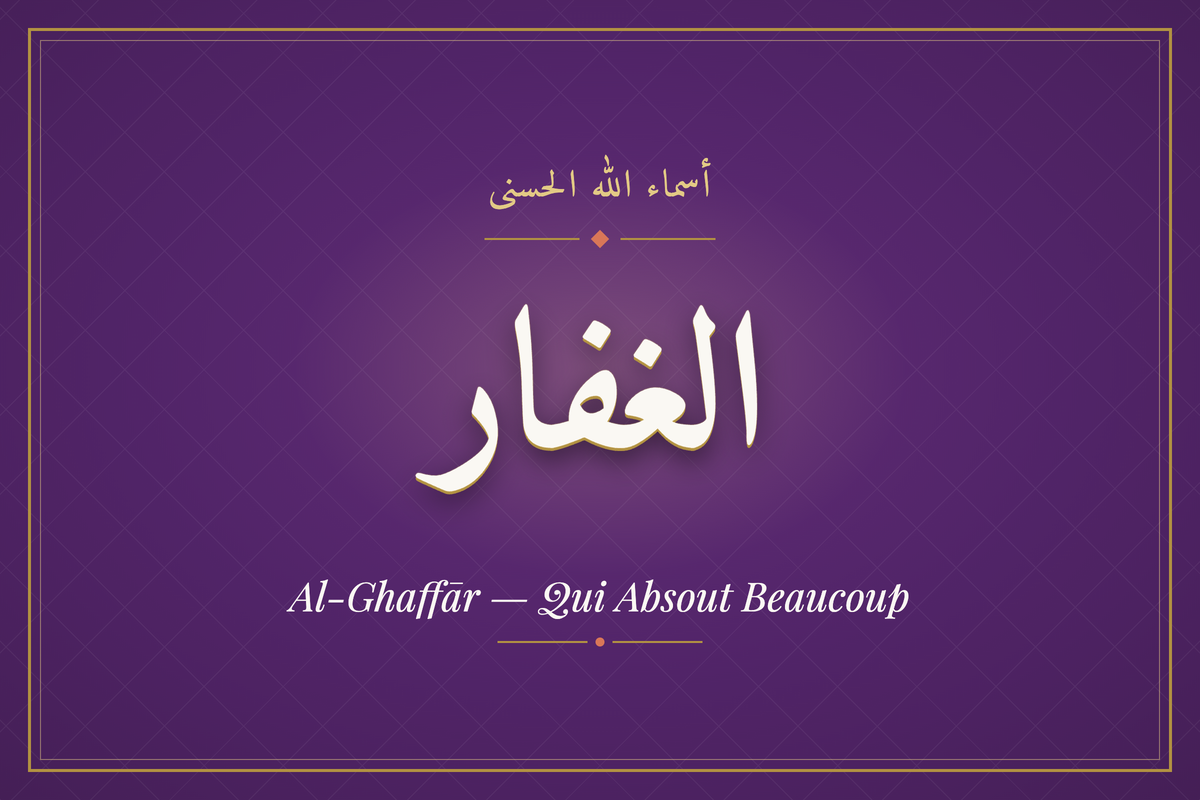
Al-Ghaffār (الغَفَّار), "The One who ceaselessly forgives," "The inexhaustible source of forgiveness," is one of the most beautiful Names of Allah. Its intensive form says it all: Allah does not forgive once, by exception — He forgives again, and again, and again, to the one who turns back to Him. Whatever the weight of your past, this Name concerns you: the door it designates never closes before the final breath.
What does Al-Ghaffār mean?
The name Al-Ghaffār comes from the Arabic root ghayn-fā'-rā' (غ ف ر), which expresses the idea of covering and protecting — the warrior's helmet is called mighfar, because it covers the head. Divine forgiveness (maghfira) is precisely that: Allah covers the fault, veils it and protects His servant from it. Applied to Allah, this Name designates:
- Repeated forgiveness: the intensive form ghaffār indicates The One who forgives without weariness, as many times as the servant returns.
- The One who covers faults: He does not merely erase the punishment, He veils the sin from the eyes of creation and spares His servant its shame.
- The One who erases traces: the sin sincerely regretted no longer stains the heart; Allah can even transform evil deeds into good ones (25:70).
Al-Ghaffār in the Quran
The prophet Nūh said to his people:
فَقُلْتُ اسْتَغْفِرُوا رَبَّكُمْ إِنَّهُ كَانَ غَفَّارًا
« I said: Ask forgiveness of your Lord, for He is the Great Pardoner. » (Surah Nūh, 71:10)
And Allah says:
وَإِنِّي لَغَفَّارٌ لِّمَن تَابَ وَآمَنَ وَعَمِلَ صَالِحًا ثُمَّ اهْتَدَىٰ
« And I am indeed the Great Pardoner to those who repent, believe, do righteous deeds, and then remain steadfast on the right path. » (Surah Tā-Hā, 20:82)
In Surah Nūh, istighfār is immediately followed by very concrete promises: abundant rain, wealth, children, gardens (71:11-12). The request for forgiveness is not only a remedy for the Hereafter: it opens the doors of sustenance in this life.

Living with Al-Ghaffār in daily life
1. Make istighfār a breathing exercise
The Prophet ﷺ said: "By Allah, I ask forgiveness from Allah and turn to Him more than seventy times a day." (Al-Bukhārī). If the purest of men lived this way, what about us? A few minutes of conscious astaghfirullāh, morning and evening, change the texture of a day.
2. Cover the faults of others
The Prophet ﷺ said: "Whoever covers (the faults of) a Muslim, Allah will cover him in this world and in the Hereafter." (Muslim). Living with Al-Ghaffār means imitating His concealment: not spreading rumors, not exposing, not humiliating.
3. Never despair of His mercy
"Say: O My servants who have transgressed against themselves, do not despair of the mercy of Allah" (Surah Az-Zumar, 39:53). Despair is an insult to Al-Ghaffār: it is to believe that your sin is greater than His forgiveness.
Invocation with the name Al-Ghaffār
The most excellent of requests for forgiveness is the sayyid al-istighfār, taught by the Prophet ﷺ: "O Allah, You are my Lord, there is no deity except You. You have created me and I am Your servant… I acknowledge Your blessings upon me and I acknowledge my sin: forgive me, for none forgives sins except You." (Al-Bukhārī). Whoever recites it with certainty in the morning and dies during the day, or in the evening and dies during the night, will be among the people of Paradise.

Frequently Asked Questions about Al-Ghaffār
What is the difference between Al-Ghaffār and Al-Ghafūr?
Both Names come from the same root. Al-Ghaffār emphasizes the repetition of forgiveness — He forgives again and again; Al-Ghafūr emphasizes its vastness — He forgives even the most enormous faults. Repetition on one side, immensity on the other.
What are the conditions for forgiveness according to the Quran?
Verse 20:82 states them: return to Allah (tawba), believe, perform good deeds and persevere in guidance. Sincere repentance requires regret, abandonment of sin and the resolution not to return to it — and reparation for wrongs against others.
Does Allah forgive major sins?
Yes, all of them, to those who repent sincerely: "Allah forgives all sins" (39:53). Only association with Allah (shirk), if one dies without having repented from it, is excluded from forgiveness (4:48).
📚 Continue reading the 99 Names
−5% off the entire library with code BLOG5
Valid on the entire site, no minimum purchase — our thanks to blog readers.
Discover our books on the Names of Allah