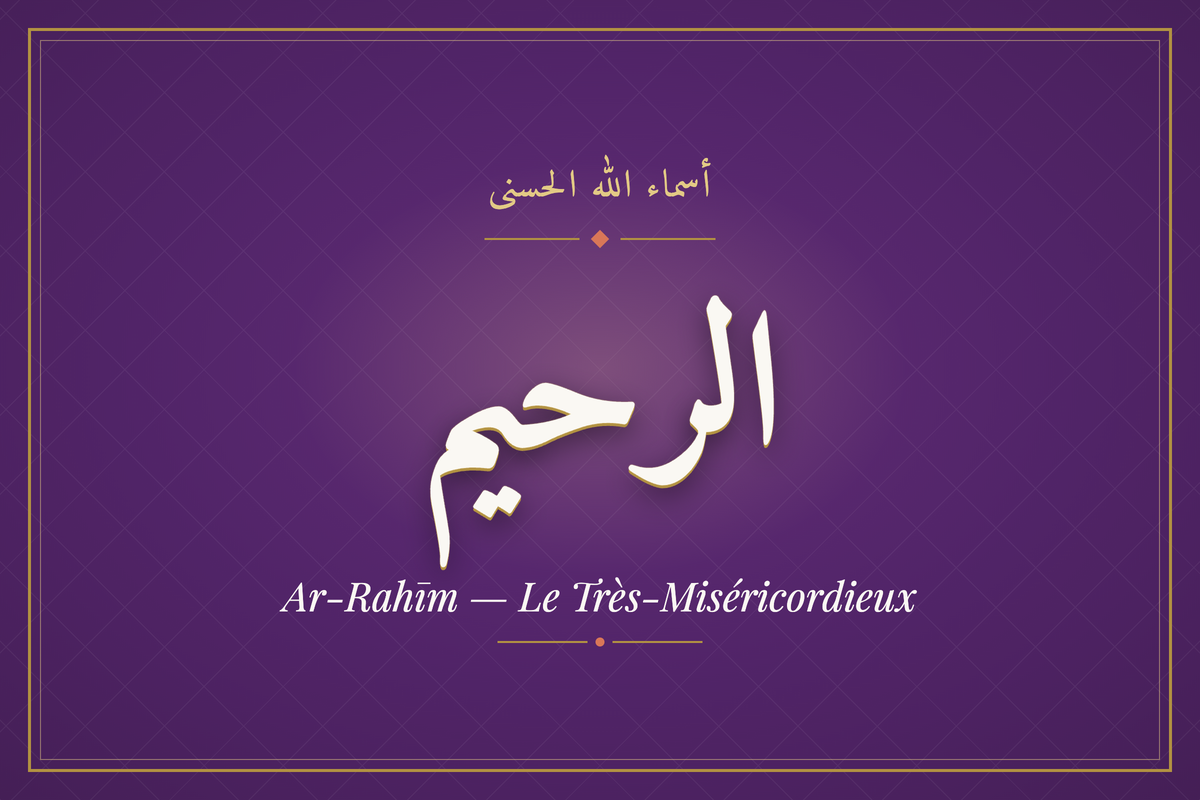
Ar-Rahīm (الرَّحِيم), "The Most Merciful," is one of Allah's Names most present in the believer's life: he pronounces it in every basmala, at the opening of each surah, at the beginning of each important act. This Name reveals a mercy that does not merely exist — it acts, it reaches, it envelops concretely and continuously every servant who turns toward his Lord.
What does Ar-Rahīm mean?
The name Ar-Rahīm comes from the Arabic root rā-hā-mīm (ر ح م), which expresses mercy, tenderness and compassion — the same root as rahim, the maternal womb, symbol of the most tender bond of all. Applied to Allah, this Name designates:
- Mercy in action: if Ar-Rahmān describes mercy as Allah's essence, Ar-Rahīm describes this mercy when it manifests itself concretely and continuously toward creation.
- Particular mercy: scholars teach that Ar-Rahīm expresses in particular the specific mercy that Allah reserves for the believers, in this world and especially in the hereafter.
- Continuous mercy: it never ceases — forgiveness after transgression, guidance after misguidance, relief after hardship.
Ar-Rahīm in the Qur'an
This Name opens the Book of Allah: the basmala — "In the name of Allah, the Most Merciful, the Very Merciful" — precedes every surah except one, and Surah Al-Fātiha proclaims it from its very first verses. Allah also says:
نَبِّئْ عِبَادِي أَنِّي أَنَا الْغَفُورُ الرَّحِيمُ
"Inform My servants that it is I who am the Pardoner, the Very Merciful." (Surah Al-Hijr, 15:49)
And concerning the believers:
"And He is Merciful to the believers." (Surah Al-Ahzāb, 33:43)
In a hadith reported by Al-Bukhārī and Muslim, the Prophet ﷺ saw a captive woman holding her child close to her and said to his companions: "Allah is more merciful to His servants than this mother is to her child." Another authentic hadith teaches that Allah created one hundred portions of mercy: only one has been distributed among all creatures — through it beings love and protect one another — and He has reserved ninety-nine for the Day of Resurrection.

Living with Ar-Rahīm daily
1. Never despair of divine mercy
He who knows Ar-Rahīm knows that the door of return remains open as long as the soul has not left the body. Whatever the fault, sincere repentance finds a Lord who loves to forgive. Despair is a misunderstanding of this Name; hope is its direct fruit.
2. Show mercy to receive mercy
The Prophet ﷺ said: "Those who show mercy, the All-Merciful will show them mercy. Show mercy to those on earth, He who is in the sky will show you mercy." (reported by At-Tirmidhī and Abū Dāwūd). Gentleness toward children, patience toward parents, clemency toward those who err: so many ways to reflect this Name.
3. Begin each act with the basmalah
Saying "Bismillāh ir-Rahmān ir-Rahīm" before eating, writing, working, is to place each moment of your day under the mercy of Allah — and to remember, dozens of times a day, He whose clemency never closes.
Invocation with the name Ar-Rahīm
The Prophet ﷺ taught this invocation: اللَّهُمَّ رَحْمَتَكَ أَرْجُو فَلَا تَكِلْنِي إِلَى نَفْسِي طَرْفَةَ عَيْنٍ وَأَصْلِحْ لِي شَأْنِي كُلَّهُ لَا إِلَٰهَ إِلَّا أَنْتَ
"O Allah, it is Your mercy that I hope for: do not entrust me to myself, not even for the blink of an eye, and set all my affairs in order. There is no deity worthy of worship except You." (reported by Abū Dāwūd)

Frequently Asked Questions about Ar-Rahīm
What is the difference between Ar-Rahmān and Ar-Rahīm?
Both Names come from the same root. Ar-Rahmān designates the immense mercy that belongs to Allah's very essence and encompasses all of creation; Ar-Rahīm designates this mercy when it acts concretely, continuously, with particular favor for the believers.
Why does the basmala unite these two Names?
By associating Ar-Rahmān and Ar-Rahīm, the basmala reminds us that Allah's mercy is both infinite in His essence and effective in His acts: everything the believer undertakes begins under this twofold protection.
How to invoke Allah by this Name?
Allah says: "To Allah belong the most beautiful Names. Invoke Him by these Names" (7:180). One can say: "Yā Rahīm, irhamnī" — "O Most-Merciful, have mercy upon me" — particularly in prostration, the moment when the servant is closest to his Lord.
📚 Continue reading the 99 Names
−5 % off the entire library with code BLOG5
Valid on the entire site, no minimum purchase — our thanks to blog readers.
Discover our books on the Names of Allah